Now for curious and interesting ‘Puzzles’.
What would you add?
Sudoku
Thinking / puzzle video games like Sokoban
Hmm, I like puzzles but my knowledge is a bit thin (and we no longer have a galvanising figure like Martin Gardner.)
Now for curious and interesting ‘Puzzles’.
What would you add?
Sudoku
Thinking / puzzle video games like Sokoban
Hmm, I like puzzles but my knowledge is a bit thin (and we no longer have a galvanising figure like Martin Gardner.)
Now suggestions for curious and interesting ‘Mathematics’. This means strange facts, anecdotes, paradoxes, portraits of eccentric mathematicians, mathematical philosophy, quotes and mathematics education.
“The only way to learn mathematics is to do mathematics.” – Paul R. Halmos
“Mathematics is not about numbers, equations, computations, or algorithms: it is about understanding.” – William Paul Thurston
“The most exciting phrase to hear in science, the one that heralds new discoveries, is not ‘Eureka!’ but ‘That’s funny…’” — Isaac Asimov
“I used to think that maths teachers were all teaching the same subject, some doing it better than others. I now believe that there are *two effectively different subjects being taught under the same name, ‘mathematics’.*’
...‘relational understanding’ [means]… knowing both what to do and why. Instrumental understanding I would until recently not have regarded as understanding at all. It is what I have in the past described as ‘rules without reasons’, without realising that for many pupils *and their teachers* the possession of such a rule, and ability to use it, was what they meant by ‘understanding’.” Richard Skemp (https://atm.org.uk/write/MediaUploads/Journals/MT077/Relational_Understanding_and_Instrumental_Understanding_–_Richard_R._Skemp.pdf)
#mathematics #MathEd #MathsEd #iTeachMath #iTeachMaths #education #AskFedi #books #quote #quotes
@foldworks I've been thinking about the early childhood math curriculum since, well, I was a early child myself.
My idea is to introduce the Stern-Brocot tree, the Symmetry Group of the Square, Pascal's Triangle, and computer programming to youngsters.
These are all incredibly fertile concepts that set up future lessons about mathematics, in lessons that are likely appropriate for children, others that are more likely to be appropriate for teens, and even others that are more likely to be appropriate for undergraduate or even graduate students.
I am very keen on finding concepts that meaningfully connect to advanced research-level mathematics, but are also approachable by the youngest children.
https://github.com/constructive-symmetry/constructive-symmetry
@leon_p_smith
Yes, I think programming can be a good way to learn mathematics (and more).
Seymour Papert wrote about this in Mindstorms (1980).
I was fortunate to learn Logo and turtle programming on a modest home computer in my early teens. I don't know which was cause and which was effect, but I still like geometry and programming today.
For those not familiar with Mindstorms, a good summary is at
https://medium.com/bits-and-behavior/mindstorms-what-did-papert-argue-and-what-does-it-mean-for-learning-and-education-c8324b58aca4
#mathematics #programming #Logo #TurtleGraphics #ITeachMath #MathematicsEducation #MathEd #MathsEd #SeymourPapert #Mindstorms
@leon_p_smith
‘Mindstorms’ is full of quotable text, here’s just one:
“Imagine that children were forced to spend an hour a day drawing dance steps on squared paper and had to pass tests in these ‘dance facts’ before they were allowed to dance physically. Would we not expect the world to be full of ‘dancophobes’?Would we say that those who made it to the dance floor and music had the greatest ‘aptitude for dance’? In my view, it is no more appropriate to draw conclusions about mathematical aptitude from children’s unwillingness to spend many hundreds of hours doing sums.” — Seymour Papert (p. 43)
#mathematics #ITeachMath #MathematicsEducation #MathEd #MathsEd #SeymourPapert #Mindstorms
@leon_p_smith
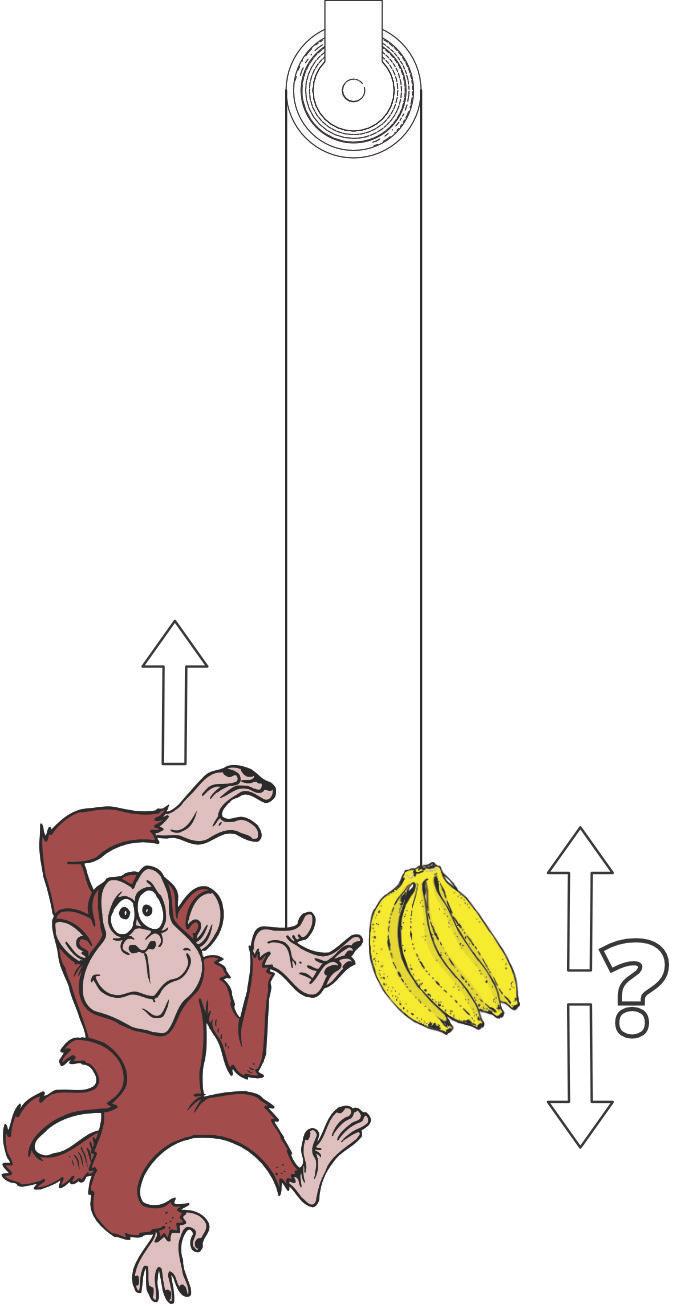
A puzzle from Seymour Papert's Mindstorms:
"A monkey and a rock are attached to opposite ends of a rope that is hung over a pulley. The monkey and the rock are of equal weight and balance one another. The monkey begins to climb the rope. What happens to the rock?"
What is your reasoning and what were your assumptions? If you know the answer, what was your first answer?
#puzzle #MathEd #MathsEd #iTeachMath #physics #mechanics
@leon_p_smith
A diagram for the question (with the rock swapped for a bunch of bananas)