@daniel Math + physics… Somehow this made me think of you. 😉
https://futurism.com/future-society/something-bizarre-inside-black-hole
@daniel Math + physics… Somehow this made me think of you. 😉
https://futurism.com/future-society/something-bizarre-inside-black-hole
Things to ponder...
Today in History, March 14, 1879, Albert Einstein was born. In addition to being one of the most significant physicists of all time, he was also a pacifist. Yet his letter to President Roosevelt warning of the Nazi progress on atomic weapons research was arguably key to the U.S. implementation of the Manhatton Project, a decision he later lamented. In 1955, well after the Cold War and nuclear arms race had begun, he and ten other intellectuals and scientists, including other Nobel Prize laureates, like Bertrand Russell and Linus Pauling, wrote a manifesto warning of the dangers of nuclear weapons. Einstein also participated in the U.S. Civil Rights movement, calling racism America’s “worst disease.” Later in his life he began to support socialism, and he criticized the Bolsheviks for their barbarism. Einstein was also a Zionist, and supported Jews’ right to return to Palestine. However, he did not support a Jewish state, or an Arab state, to replace Mandatory Palestine. Rather, he wanted a free, bi-national Palestine in which Jews and Arabs shared sovereignty, living peacefully and equally with each other.
#workingclass #LaborHistory #einstein #nazis #fascsim #pacifism #antisemitism #zionism #palestine #israel #physics #atomicbomb #nuclear #socialism #civilrights #racism #nobelprize
From a colleague at Donostia / San Sebastián (Basque, Spain):
We have a fully funded predoctoral position at my group for a Chemist, a Physicist or related. The project is somehow flexible and can be directed more towards spectromicroscopy or spectroscopy:
https://dipc.ehu.eus/en/dipc/join-us/x-rays-for-inorganic-biochemistry-laboratory
And a short postdoc for an X-ray spectroscopist (ideally the contract will be extended, but will depend on funding that is been requested). Ideally with X-ray or neutron scattering experience, but Absorption or other spectroscopies might be also interesting:
Here is my lecture on EM plane waves for #electrodynamics #physics. Yes, I include a #python model for a plane wave
Magnetars drag spacetime to power superluminous supernovae https://arstechni.ca/Q8qw #generalrelativity #astrophysics #supernova #magnetar #Science #Physics
from #physics class today (#electrodynamics) - EM plane wave in #python
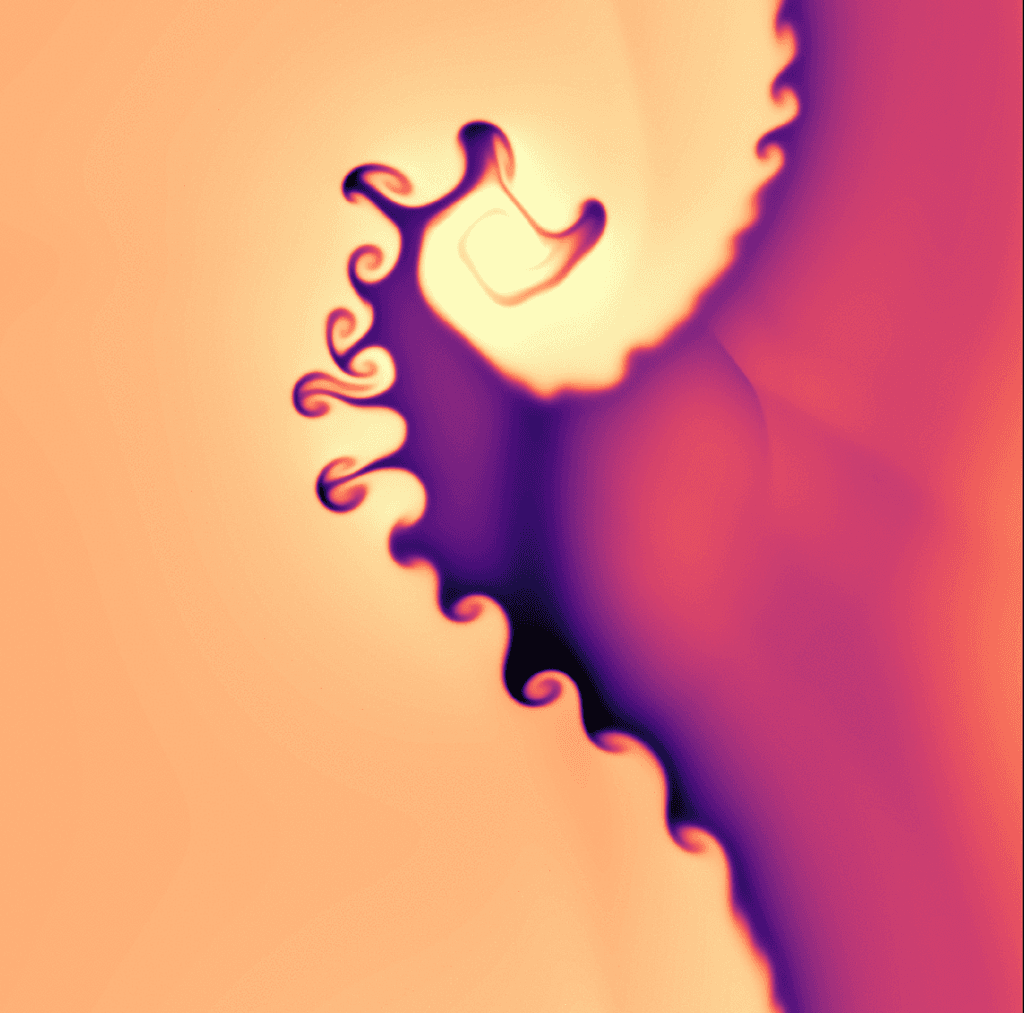
Richtmyer-Meshkov Instability
If you send a shock wave through a magnetized plasma–something that happens in both supernova explosions and inertial confinement fusion–it can trigger an instability known as the Richtmyer-Meshkov instability. The image above shows a form of this, taken from a simulation. Rather than treating the plasma as a single idealized fluid, the researchers represented it as two fluids: an ion fluid and an electron fluid. This allowed them to better capture what happens when certain components of the plasma react to changes faster than others do.
The image itself shows the electron number density across the fluid, where darker colors represent higher electron number density. The interface between high and low-densities shows a roll-up instability that resembles the Kelvin-Helmholtz instability, but there are also regions of mushroom-like plumes that more closely resemble Rayleigh-Taylor instabilities.
The authors note that these structures don’t appear in simulations that represent a plasma as a single fluid; you need the two-fluid representation to see them. (Image and research credit: O. Thompson et al.)
#CFD #computationalFluidDynamics #fluidDynamics #instability #KelvinHelmholtzInstability #magnetohydrodynamics #numericalSimulation #physics #plasma #RayleighTaylorInstability #RichtmyerMeshkovInstability #science #shockwave“What is really amazing, and frustrating, is mankind’s habit of refusing to see the obvious and inevitable until it is there, and then muttering about unforeseen catastrophes”*…
Rubble left in the aftermath of Hurricane Michael is pictured in Mexico Beach, Florida, U.S. October 11, 2018. REUTERS/Jonathan Bachman (source)One of the effectively-secret ingredients in the world’s economic growth over the last couple of centuries has been insurance. The ability to insure against catastrophic loss has underwritten (pun intended) the trillions and trillions of dollars of loans that have funded the construction and acquisition that has enabled the growth of both commercial endeavor and the the accumulation of personal wealth (directly through home ownership and indirectly through equity ownership in those commercial endeavors or participation in pension schemes that own that equity).
But in a way that was enitrely predictable, climate change is rendering a growing portion of the world uninsurable. Gavin Evans ponders what that might mean…
The Florida peninsula looks like a sore thumb. It juts into the Gulf of Mexico and the Atlantic, where the water is getting warmer year on year, prompting fiercer hurricanes that can blow down houses like collapsing decks of cards. Climate scientists are convinced all hell will break loose sooner or later when a monster-sized, property-destroying storm makes a direct hit on Miami or Tampa-St Petersburg. Given three near-misses in the recent past, the experts view such a calamity as inevitable. It’s a huge risk for anyone living there – they stand to lose everything – but also for those bearing the financial side of this risk, the insurance companies. Some in the industry are seeing this as a portent for their future – an impending existential threat with profound implications for the economic system.
There are no easy solutions for people still paying off mortgages and those who want to buy property along the Florida coast, because the potential payout on the back of a mammoth storm is so high that the reinsurers (who insure the insurers against catastrophe) are refusing to underwrite their clients and, with no reinsurance, there’s no insurance; and with no insurance, no mortgages; and with no mortgages, no property market. Insurance protects investments against loss and is therefore a pillar of the economic system. If it goes, economies are destabilised.
Many panicked homeowners have rushed to make their houses less risky for insurance companies by reinforcing their roofs with hurricane clips, installing impact-resistant windows, doors and shutters, and strengthening their foundations. But it’s not just storms and higher, warmer seas that concern insurers. Rising temperatures mean that the frequency, range and ferocity of wildfires are also on the rise.
So far this year, 3,374 wildfires have burned an area of Florida totalling 231,172 acres (at the time of writing), and it is even worse in California where 7,855 blazes have killed at least 31 people, destroyed more than 17,000 houses and devoured 525,208 acres of land, at an estimated cost of more than $250 billion. Here, too, homeowners rushed to make their properties more palatable to cold-footed insurers – clearing their surroundings of anything flammable, covering yards with gravel, sheathing houses with fire-resistant stucco, and replacing wooden roofs with steel.
But, even for the most diligent, insurance companies have turned tail, dumping existing clients and abandoning fire-prone and storm-prone areas altogether. On the Californian fire front, 2024 was a turning point as several insurers ceased issuing new policies because of fire-associated risks, including the United States’ biggest property insurer, State Farm, which cancelled policies in parts of Los Angeles. It is all too easy to view this cynically, but it’s happening because property insurers have been reporting year-on-year losses from climate change-related payouts.
Insurance companies survive by making more money from covering risk than they lose from these risks, which is why they prefer clients less likely to claim (insofar as they can predict the risk involved) and require them to pay substantial excess to discourage claims. When payouts rise above the premium intake, insurance companies either hike up these premiums or withdraw. But when that risk is considered catastrophic, potentially affecting many thousands of clients, as with Floridian storms and Californian fires, it is the reinsurers who are the first to retreat because they will ultimately bear most of the cost.
Reinsurers aggregate payout patterns to establish the likelihood of having to make huge payouts from future natural catastrophes. They do this by gathering exposure data from existing insurers in a geographical area, and by examining catastrophe models (computer simulations that estimate potential losses from natural perils). When they put all this together with detailed analysis of conditions within the area, they come up with a figure for their total potential loss if a catastrophic event strikes.
This is why reinsurers focus so intensely on climate change. Take a glance at the websites of big ones like Swiss Re and Munich Re and you get a sense of how central this is to their calculations – a concern that has spread to property insurers who are starting to hire climate consultants. Even more than market volatility, climate is their biggest headache. ‘You won’t meet a single insurance or reinsurance CEO who doesn’t believe in climate change,’ the insurance investor and former Lombard Insurance CEO James Orford told me. ‘They see it in the numbers – a combination of more extreme, less predictable events, combined with big losses of sums insured. All the modelling suggests these are uninsurable risks.’…
[Evans recaps the history of insurance, starting in Genoa, in the mid-14th century, with the insuring of maritime expeditions; examines the current state of play; examines the efforts (and gauges the weaknesses) of state’s efforts to step up with coverage when insurers step away; then considers another role for states…]
If states do withdraw from insurance and reinsurance, some of the most lucrative areas of the US, Canada, Europe, Asia, Africa and Australia will be devastated: no mortgages and no banks, leading to more ghost towns and villages. ‘It ends with depopulation and abandonment,’ said Agarwala. ‘Climate change reduces the operating space for humanity.’ In the UK, rising sea levels and coastal erosion could literally reduce operating space, putting 200,000 British homes at risk by 2050. There’s no coastal-erosion insurance, which puts more burden on the state, mainly to pay for new defences, but also to help people move.
Governments can take action in other ways, by investing greater sums in risk-prevention and management. There are signs of this happening such as the ‘fire-hardening’ and storm-prevention efforts in Florida, and improved flood defences in the UK; meanwhile, the EU’s Recovery and Resilience Facility is being used in several countries to build and renovate operations centres to cope with wildfires, and to buy firefighting helicopters.
In future, it is likely that voters will demand that their state and national governments do far more, regardless of the cost. They will want tougher building codes, including limitations on building in risky areas; expensive fire-prevention and fire-fighting schemes; better flood and storm defences; improved early catastrophe management, involving relocating people from risky areas and, when disaster strikes, rapid life-saving interventions such as large-scale emergency evacuations. If the insurance industry is forced to retreat by the climate crisis, all of this infrastructural investment will require vast chunks of taxpayers’ money. It is hard to avoid the feeling that this is part of our destiny, and that the sore thumb of the Florida peninsula is pointing us to the future…
Whole regions of the world are now uninsurable, bringing radical uncertainty to the economy: “The insurance catastrophe,” from @aeon.co.
See also: “An Uninsurable Country” (a report form NRDC), “The Insurance Crisis Is So Desperate People Are Turning Socialist” (a gift article from Bloomberg), and “The Uninsurable Future: The Climate Threat to Property Insurance, and How to Stop It” (from Yale Law Review)
* Isaac Asimov
###
As we cover up, we might send highly-charged birthday greetings to a man who made foundational contributions both to the detection of climatic conditions and to a technology that may help allieviate climate change: John Frederic Daniell was born on this date in 1790. Named the first professor of chemistry at the newly founded King’s College London in 1831, he was an avid meteorologist. He invented the dew-point hygrometer known by his name and a register pyrometer; in 1830 he erected a water-barometer in the hall of the Royal Society.
But Daniell is better remembered as a chemist (and physicist), especially for his invention of the Daniell cell, an element of an electric battery much better than voltaic cells, the standard before him. Indeed, the Daniell cell is the historical basis for the contemporary definition of the volt (the unit of electromotive force in the International System of Units). All advances in battery technology since then were “from” the base that Daniell laid.
#chemistry #climate #climateChange #culture #DaniellCell #disasters #economics #finance #flooding #history #insurance #investment #JohnDaniell #JohnFredericDaniell #meteorology #Physics #reinsurance #Science #Technology #volt #weather #wildFires

So if water doesn’t compress, what would happen if you dumped a meters depth of water over the entire surface of a white dwarf star?
My #introduction in #English seems to have been lost in moving instances, so here's a fast-drawn new one in hashtags:
#science #physics
since 2021 working on
#fiberlinks #frequency #time #transfer #reference #quantum #metrology
before that on
#biophysics #raman #spectroscopy #microscopy #biofilm #bacteria #protein #microplastics
#programming
#python (#fortran #mathematica )
Other interests:
#plants #cats #sciencefiction #fantasy #reading #writing #audiobooks
It's time for an #introduction, having just moved over from another instance.
I'm a career changer, after three decades teaching physics and computer science in schools and colleges. I'm now an instructor in the aviation industry and enjoying the change of pace.
I'm interested in #Rugby, #Cricket,, #pedagogy, #physics, science, technology and #education in general. I've run a local #astronomy society, a target shooting range and a badminton club.
I have an occasionally updated #Gemini log, a set of #RaspberryPi computers running network services, and I started programming on a Sinclair ZX81 microcomputer.
I enjoy winge-bonding about the failures of politics, irritatingly smug tech billionaires and the stupidity of the #england national rugby team manager. I prefer calming countryside photos, happy tales and stories of positive experiences.
Driving a LED at sub-nA currents, allows me to measure single photons, thereby proving that light acts like small energy bunches 👌🏼😎😎
See my previous video if you want to know more about the setup and the PMT (Photo Multiplier Tube)
🤯 When your #physics theory sounds like a #sci-fi screenplay and even the string theorists roll their eyes. Who knew #fractals could bend space-time and our patience simultaneously? 🌀✨
https://www.quantamagazine.org/where-some-see-strings-she-sees-a-space-time-made-of-fractals-20260311/ #spacetime #stringtheory #mindblown #HackerNews #ngated
Testing Structures Against Hurricane Storm Surge
When hurricanes hit coasts, they bring with them incredible storm surge, which puts buildings right in the middle of ocean waves. To understand how to better protect against those conditions, engineers use facilities like the Directional Wave Basin to create smaller-scale versions of hurricanes. In this Practical Engineering video, Grady visited during a test that compared two identical one-third-scale houses subjected to the same storm conditions–except that one house had an additional foot (3ft at real-scale) of elevation. The results are pretty spectacular.
This isn’t a short video, but it’s well-worth a watch. I think Grady does a great job of explaining why engineers need (admittedly) expensive facilities like this one to help guide both engineering and regulatory decisions. (Video and image credit: Practical Engineering)
#civilEngineering #dynamicSimilitude #engineering #experimentalFluidDynamics #fluidDynamics #hurricanes #oceanWaves #physics #science #waveTank
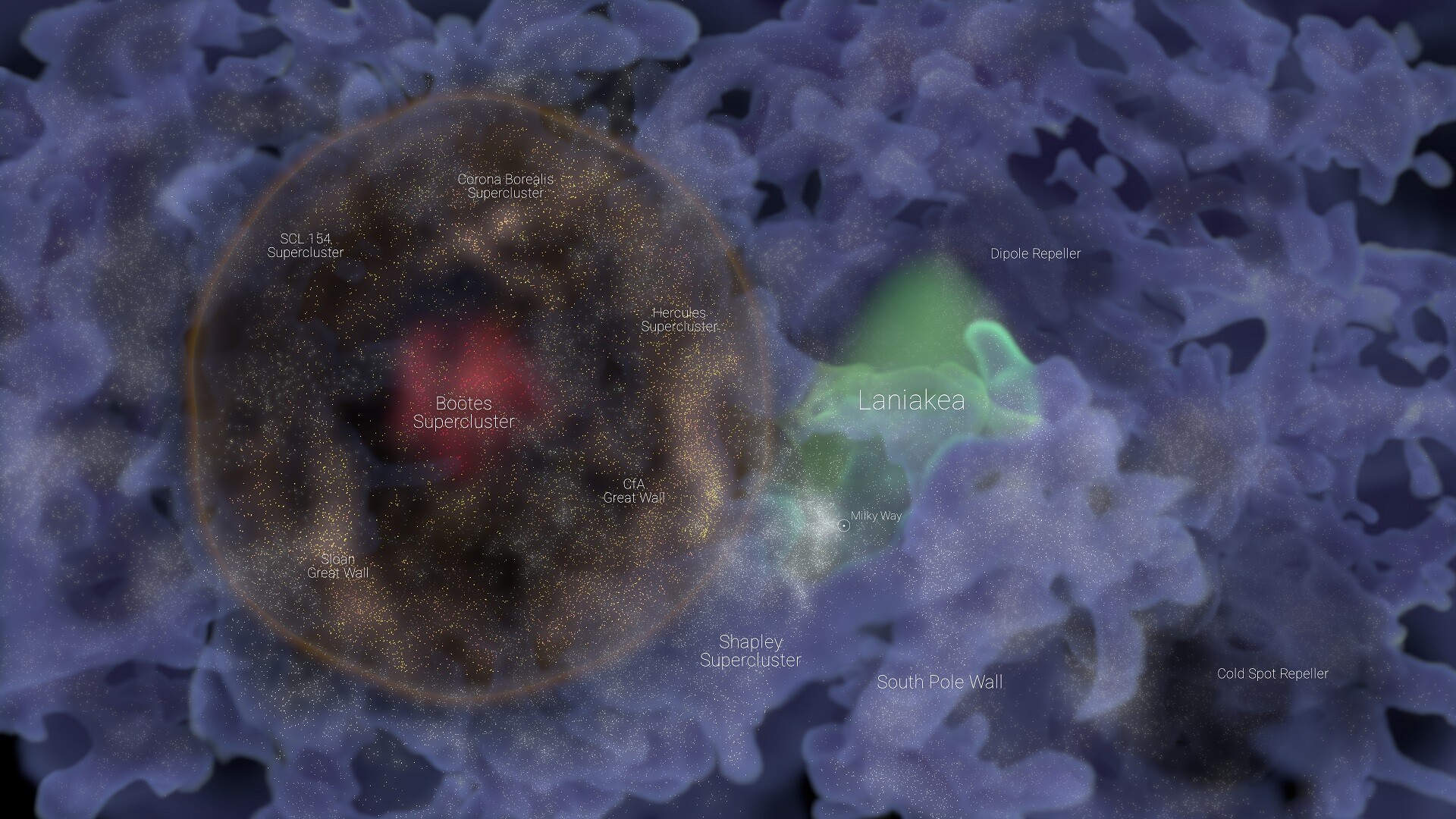
Discovery alert!
A spherical shell-like structure 1 billion light-years in diameter named Ho’oleilana is discovered in the distribution of relatively nearby galaxies. We posit this is the 1st observation of an individual Baryon Acoustic Oscillation (BAO).
https://doi.org/10.3847/1538-4357/aceaf3
#hooleilana #cosmology #bao #baryon #acoustic #oscillations #astronomy #astrophysics #astrodon #universe #space #science #research #discovery #cosmography #map #maps #superclusters #physics #theory #bigbang #lcdm
Bueno, estuve haciendo algunos star test en el telescopio nuevo y para mi sorpresa, se trata de un excelente lente, prácticamente sin aberraciones o por lo menos del orden de lambda/10 P-V lo cual significa que el prácticamente perfecto. El star test consiste en tomar una estrella brillante y tomar imagenes enfocada y desenfocada unas 4 ondas (que en mi caso son unos 3.9mm lo que hice con algo de incertidumbre) intra y extra focal y examinar el patrón de difracción de anillos. Las imágenes deberían ser en una óptica ideal, exactamente iguales. Nunca es el caso con ópticas reales y hasta los objetivos más caros suelen no pasar la prueba 100%. La intensidad de los anillos concéntricos revela una suavidad muy grande de la superficie o smoothness. Además de la ausencia de astigmatismo, coma y practicamente de aberración esférica. La aberración esférica es el terror de los telescopios refractores acromáticos y también apocromáticos, debido a que de las aberraciones primarias, es la única que es proporcional al inverso de la distancia focal al cubo, por lo que objetivos de corta distancia focal suelen no controlarla muy bien. En mi star test se observa algo de aberración esférica subcorregida muy mínima, del orden de lambda/10 común en las ópticas premium. La MTF del lente es prácticamente la teórica y el strehl ratio es del orden de 0.97 - 0.98 lo cual es inmejorable para un objetivo acromático Fraunhofer clásico, incluso comparable a un apocromático. El programa WinRoddier francés, estima un error P-V de lambda/12 y un error RMS de lambda/82 lo cual me parece un poco mucho, pero ta. Eventualmente voy a repetir el star test en mejores condiciones y con los desenfoques precisamente simétricos. Le envié el test que hice al fabricante del telescopio para manifestarle que es excelente el diseño y que cumplió con lo que el dice en la página, y me contestó invitandome a poner el test en su página, lo cual para mi sería un honor. Que pena que no se pueda vivir de esto. Como mensaje final para los fanáticos de los apocromáticos (y como de cada cosa que hago, elijo emprender una causa, en este caso, por los acromáticos largos oldschool), sepan que un acromático de estos le pisa los talones si no anda mejor en lo referente a resolución, ya que al controlar tan bien la aberración esférica originada en las 4 superficies esféricas del duplete, posiblemente resulte menor que en los objetivos apocromáticos que tienen 6 superficies esféricas con las que lidiar. Además, la tolerancia a los errores superficiales en el caso de los apocromáticos, es unas 10 veces menor que en un duplete, por lo que los apos, tienen que estar muy pero muy bien figurados para no contaminar la imagen con el clásico halo de luz parásita proveniente de la esférica a grandes magnificaciones, lo que de paso explica, porqué los acromáticos son invencibles en resolver estrellas dobles. Tengo una máquina de resolver dobles, efectivamente. Síganme para más tips sobre testeo de lentes y espejos de telescopios. #fraunhofer #doublet #telescope #telescopio #acromatico #achromat #kasai #japan #optica #optics #fisica #physics #diffraction #difraccion
I should probably try making short reviews of these books I've been buying and reading recently.
https://mastodon.social/@franco_vazza/116205809679984112
A perfectly legitimate question would be:
why on earth do you end up teaching stuff you are not qualified to teach at a master level??
Here my 3 answers
a) because no one else in an entire astrophysics & cosmology course would teach them
b) because you realise only halfway through the preparation, that you probably are not qualified
c) because that's the only way you would really study and struggle to understand it (I think Feynmann got here much before me)
VIM
Bram Molenaar
human programming
Background
It has come to my attention that my beloved VIM has become invested with LLM AI slop
The lead programmer is not following standard rules of coding anymore.
People have called him many things, but one thing is certain. The man is intelligent in the programming field and knows what he wants.
VIM needs LLM slop!
the programmer screams!
We don't think so!
we roar back!!!
A couple of programmers decided to create a hard fork of vim
VIM
version V9.1.0 January 2K24
last commit
no LLM slop
Pure Bram Molenaar level human crafted code
If you are categorically against large language model slop this is a project for you to support!
This is a hard Fork meaning that you cannot merge it back with me VIM main source line
Project
https://codeberg.org/NerdNextDoor/vim
Source
https://mastodon.social/@mrmasterkeyboard/116192873098653079
https://codeberg.org/NerdNextDoor/vim
#VIM #VIMMasterRace #programming #LLM #AI #hostile #environment #Amiga #BSD #freeBSD #netBSD #openBSD #ghostBSD #LINUX #mac #win64 #OpenSource #POSIX #technology #mathemathics #physics
Just completed my by far most difficult lecture ever with astronomers - get them a sense of the #Higgs mechanism, of the Higgs boson and of the Higgs field in one hour, after a couple of weeks of shallow overview of the Standard Model.
Not sure how it went, but I prepared for a couple of weeks like for a job interview, and my mind exploded 🤯
It won't even be in the final exam, but I tried it first time this year.
Done, exhausting, also because I am not qualified for this.
#physics #science

Improving Turbulence Models
Calculating turbulent flows like those found in the ocean and atmosphere is extremely expensive computationally. That’s why forecasting models use techniques like Large Eddy Simulation (LES), where large physical scales are calculated according to the governing physical equations while smaller scales are approximated with mathematical models. Researchers are always looking for ways to improve these models–making them more physically accurate, easier to compute, and more computationally stable.
In a new study, researchers used an equation-discovery tool to find new improvements to these models for the smaller turbulent scales. They started by doing a full, computationally expensive calculation of the turbulent flow. The equation-discovery tool then analyzed these results, looking to match them to a library of over 900 possible equations. When it found a form that fit the data, the researchers were then able to show analytically how to derive that equation from the underlying physics. The result is a new equation that models these smaller scales in a way that’s physically accurate and computationally stable, offering possibilities for better LES. (Image credit: CasSa Paintings; research credit: K. Jakhar et al.; via APS)
#CFD #computationalFluidDynamics #fluidDynamics #geophysics #largeEddySimulation #machineLearning #mathematics #numericalSimulation #physics #science #turbulenceThis happened to me both in the sim and in real life! 😅🏎💨 Almost lost the rear under braking in a fast corner.
#Motorsport #Racing #Simracing #Unity #MadeWithUnity #GameDev #Physics #Simulator
Formalizing research #mathematics with #leanprover is normal these days, but now people are formalizing #physics results as well, to bring it up to that level of rigor – and already the first paper they look at falls apart, with the main theorem being (provably) incorrect: https://arxiv.org/abs/2603.08139